Palmear
View live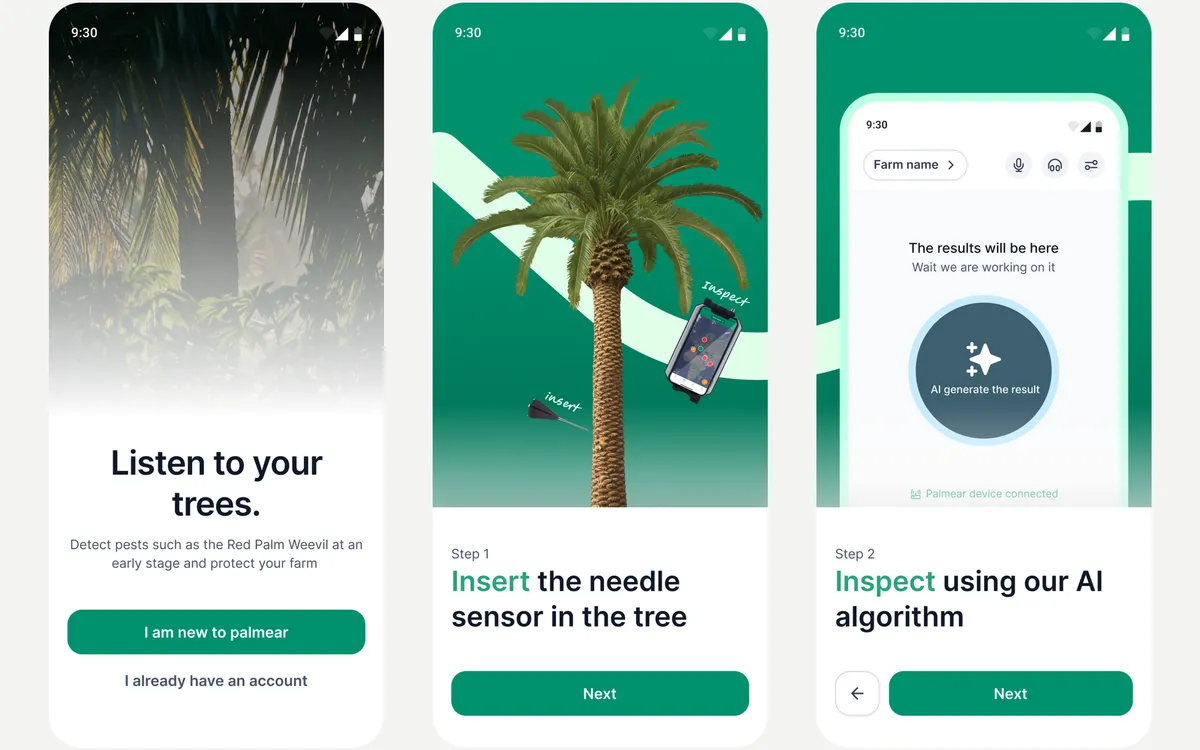
The Red Palm Weevil eats a palm tree from the inside. By the time the damage is visible from the outside, the tree is usually gone. Palmear puts a needle sensor into the trunk, listens, and runs the audio through an AI model to say whether something is living in there.
I designed the mobile app that runs that sensor, across two flows: the onboarding a new grower goes through, and the working app they use in the field afterwards.
Explaining a sensor to someone standing in a field
Most of the onboarding problem is comprehension, not data entry. Someone downloading this app has probably never used an acoustic sensor. So the flow opens by naming the job in plain language, listen to your trees, then shows the two physical steps before asking for anything: insert the needle into the trunk, then inspect with the AI. Understanding first, account second.
Onboarding that sells

The unusual part of this project is that onboarding is also the sales channel. As the grower sets up, the app asks what it needs anyway, farm size in number of trees, country, city, then puts the hardware and subscription in the same flow: sensor, annual plan, delivery, one total, one payment.
That means a lead arrives already qualified. The team knows the farm size and location before anyone speaks to them, and the grower can buy without leaving the app or waiting for a call.
Around 20% of leads from the app convert into direct sales, and the app became a lead source in its own right rather than a tool given to customers after the fact.
The field app
After setup, the app is a working instrument. Readings are tagged to a location on the farm map with a clear status, not detected, suspicious, detected, so a walk through the plantation produces a map of where the problem actually is. Device manual, subscription and support sit one tap from the home screen, because the people using this are outdoors with a device in one hand.